
How fast are WooCommerce stores in 2026? What 186,634 stores tell us
Google's real-visitor data for 186,634 US-audience stores: WooCommerce shows main content in 2.2 s on phones, Shopify in 1.3 s. Where the gap comes from.
A typical WooCommerce store in the US takes 2.2 seconds to show its main content on a phone. A typical Shopify store takes 1.3. That is the short version of our State of WooCommerce Store Speed 2026 report, which looks at Google's real-visitor speed data for 186,634 online stores with a US audience.
We wrote this post for store owners who want the parts that matter to them without the method section. The full report has the charts, the tables, the SQL and a CSV of every number.
Where the data comes from
Chrome records how fast pages load for real visitors who agree to share usage statistics, and Google publishes the results every month as the Chrome UX Report. We took the September 2026 figures for phones in the US and matched them with HTTP Archive's crawl of the same month, which tells you which platform each site runs on. No lab tests, no single runs from one office connection. For each store the number is the time that 75% of its phone visits came in under, which is how Google judges a site.
WooCommerce passes less often
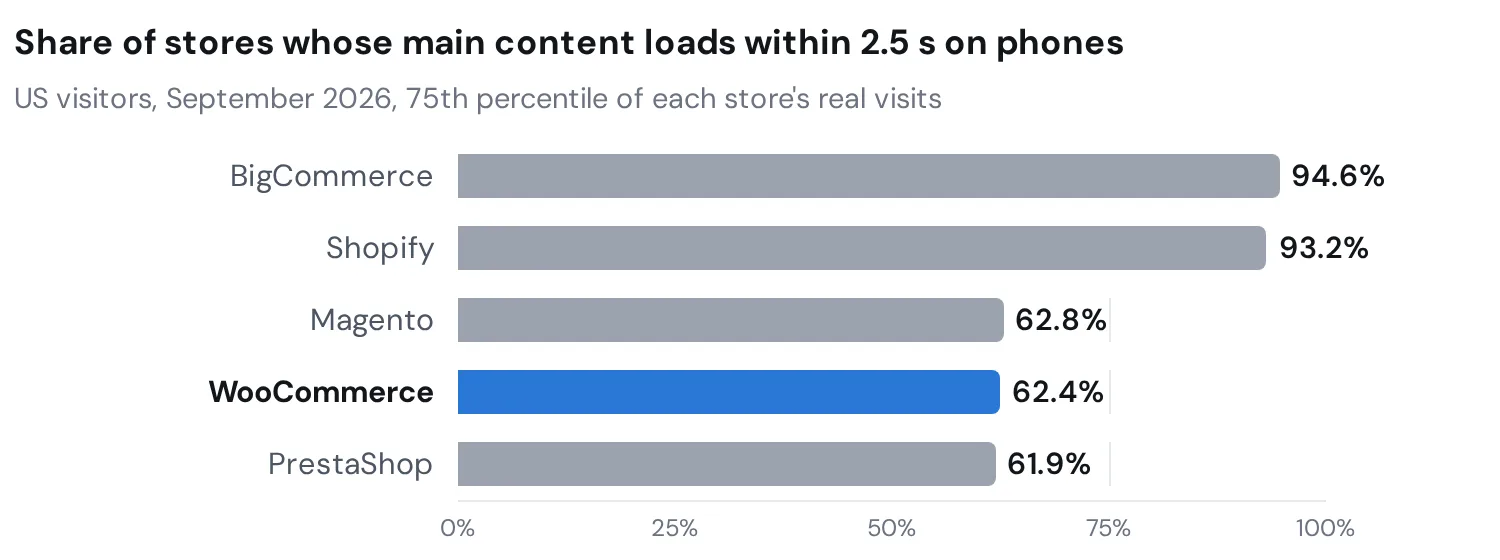
Google calls a page good when its main content (Largest Contentful Paint) shows within 2.5 seconds. 62% of WooCommerce stores manage that. On Shopify it is 93%, on BigCommerce 95%. Magento and PrestaShop sit right next to WooCommerce at 63% and 62%.
Where does your store sit in this? The free store speed test measures your own store on a simulated phone in about three minutes, so you can compare it with the numbers below. If the server turns out to be the slow part, that is what our managed WooCommerce hosting is for.
The obvious objection is that Shopify has more big brands with big budgets. So we compared stores of similar popularity, using the bands Chrome itself puts sites into. WooCommerce is behind in every band, from the most visited sites down to the small ones.
The server is most of the gap
The clearest difference is the wait before the first byte of the page arrives. On Shopify, 92% of stores get it to a phone within 0.8 seconds, Google's guideline. On WooCommerce it is 22%. The median WooCommerce store needs 1.4 seconds before anything arrives, which is already longer than the median Shopify store needs for the whole main content.
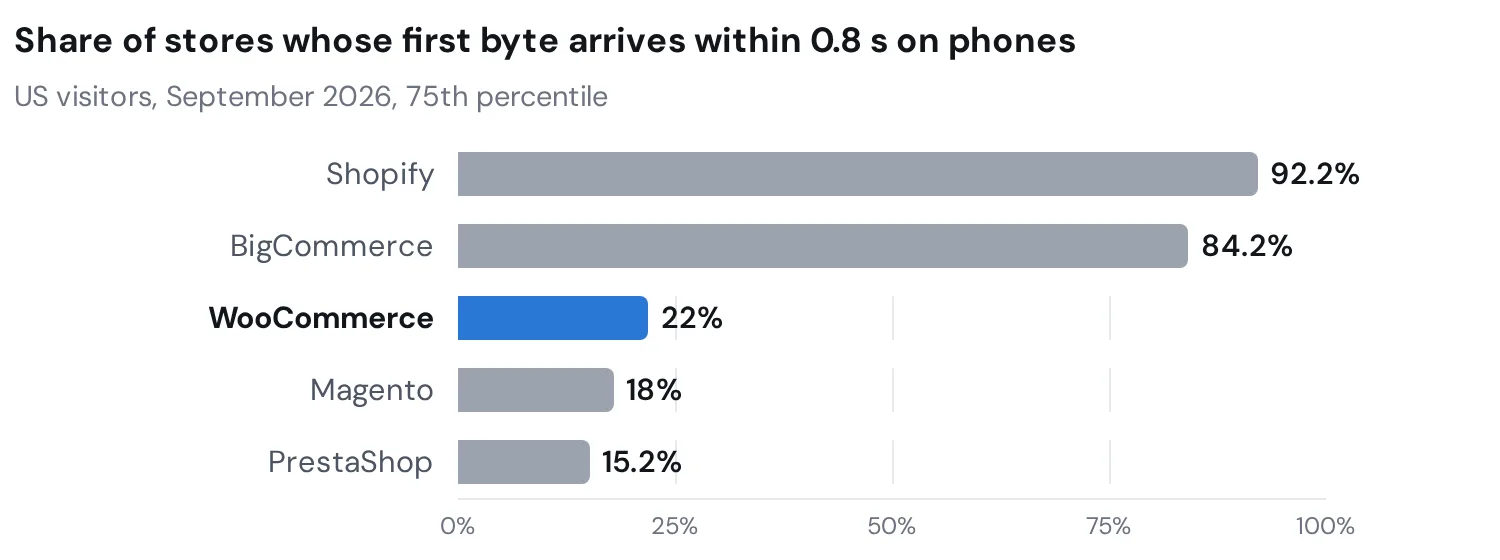
This is the part a WooCommerce store owner controls, and it is usually not mysterious. When we open a slow store, we tend to find no page caching, a crowded shared server, or a plugin that runs heavy database queries on every page view. A faster theme does not help much while the server is still thinking.
Plugins and JavaScript add up
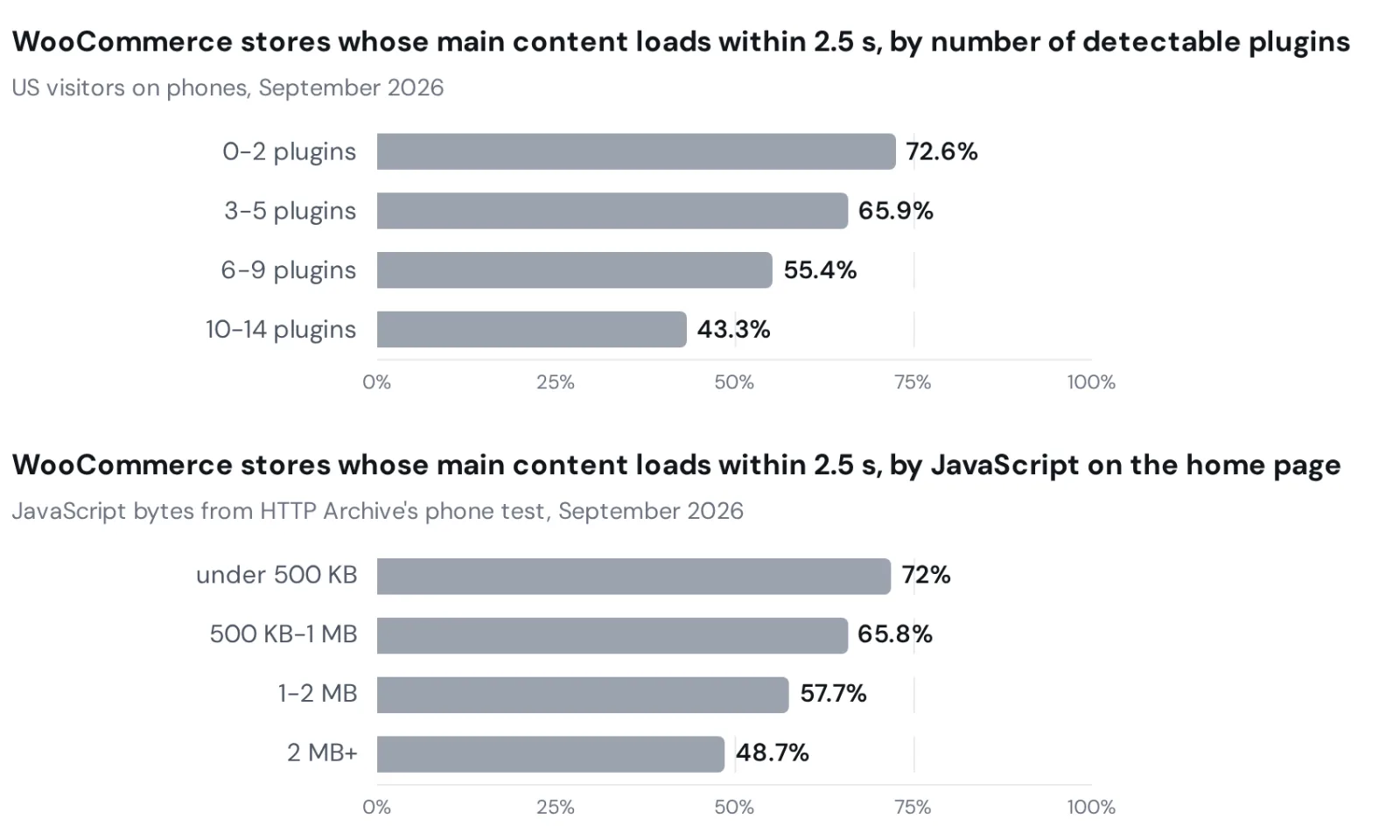
Stores with more plugins we could detect from outside, and stores that send more JavaScript to the phone, pass less often. 73% of WooCommerce stores with 0 to 2 visible plugins pass the 2.5-second mark; with 10 to 14 it drops to 43%. Under 500 KB of JavaScript, 72% pass; over 2 MB, 49%. Bigger stores do more, so part of this is size, not waste. Still, in our experience a slow store rarely has one bad plugin. It has fifteen ordinary ones.
Old software is common, but it is not the main speed problem
Of the WooCommerce stores where the version could be read, 23% are one major version behind and 9% are two or more behind. Those stores are only slightly slower than the up-to-date ones. Old WooCommerce is mostly a security and compatibility problem.
PHP is a different story. Among the WooCommerce stores whose server announces its PHP version, 30% run PHP 8.1 or older, which no longer gets security fixes. Our own crawler found that 60% of the US-audience PrestaShop stores it could read run versions that are no longer patched.
Hosting shows up in the numbers
72% of WooCommerce stores on managed WordPress hosting pass the 2.5-second mark, against 63% on mass-market web hosts. That does not prove the host is the whole reason. Stores on managed hosting tend to have someone looking after them. But it fits what we see: the server and the way it is set up decide a lot of the first second.
What to do with this
Measure your own store before you change anything. Our free store speed test checks your home, category, product and cart pages on a simulated phone and says where the time goes. The version checker tells you in a few seconds whether your WooCommerce, WordPress or PHP is behind.
If you want the full picture, with every table and the method, read the State of WooCommerce Store Speed 2026 report. The data is free to reuse with a link.